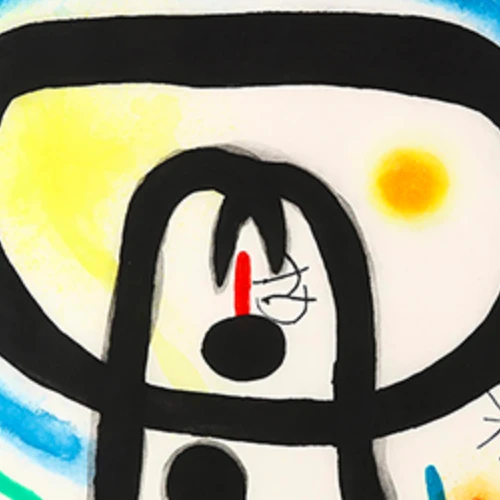
Joan Miró, L’Exposition d’oeuvres récentes, 1953, signed and numbered lithograph before the poster lettering, Mourlot 191.Joan Miró created both original limited-edition lithographs and genuine lithographic posters. Some poster images were also issued before the lettering in smaller hand-signed and numbered editions.
Later offset posters, photomechanical prints and decorative reproductions can use the same Miró imagery without being original graphic works.
The key is to identify the exact documented edition and compare its Mourlot reference, printing technique, paper, dimensions, signature and edition structure.
What Is an Original Joan Miró Lithograph?
An original Joan Miró lithograph is a graphic work created through the lithographic process and documented as part of Miró’s graphic oeuvre.
Depending on the edition, it may be signed and numbered, unsigned as issued, an artist’s proof, an H.C. impression, part of a portfolio or related to an exhibition poster.
Miró lithographs are primarily identified through Joan Miró Lithographe using a Mourlot or M. number.
Browse the Joan Miró Catalogue Raisonné →
Can a Joan Miró Poster Be an Original Lithograph?
Yes.
Miró created numerous original lithographic posters for exhibitions, museums, galleries, films and cultural events.
For example, Christie’s documents Miró’s Poster for Exhibition of 1948, Mourlot 67, as an original color lithograph. The project included proofs before the exhibition lettering as well as an unsigned poster edition of 300.
Both belong to an authentic Miró lithographic project, but they differ in signature, edition structure, scarcity and collector value.
What Does “Before Letters” Mean on a Miró Lithograph?

A before-letters or before-text impression was printed before exhibition titles, gallery information, film credits or other typography was added to the poster design.
In some Miró projects, these impressions were issued in smaller hand-signed and numbered editions.
For example:
Poster for the Miró Exhibition at the Musée National d’Art Moderne, 1962 — Mourlot 337, signed edition before the lettered poster
L’Exposition d’oeuvres récentes, 1953 — Mourlot 191, signed and numbered edition of 150 before lettering
“Before letters” describes the state of the image; the edition still needs to correspond with the documented catalogue entry.
Original Miró Lithograph vs. Poster vs. Reproduction
| Type | What It Means |
|---|---|
| Original limited-edition lithograph | Original graphic work issued in a documented edition |
| Signed before-letters lithograph | Impression printed before poster text, often from a smaller signed edition |
| Original lithographic poster | Original lithograph created for an exhibition, institution, film or event |
| Unsigned poster edition | Authentic documented poster edition, but not necessarily signed or scarce |
| Reproduction poster | Later reproduction of an existing Miró image |
| Offset reproduction | Photomechanical reproduction rather than an original lithographic impression |
The same Miró image can therefore exist in more than one legitimate form. The exact catalogue entry and edition structure determine what the individual object is.

Hand-Signed, Printed and Unsigned Miró Posters
A Miró poster does not have to be hand-signed to be an authentic original lithographic poster. Some documented poster editions were issued unsigned.
However, collectors should distinguish:
- Hand-signed — Miró individually signed the impression, usually in pencil
- Signed in the stone — the signature is part of the lithographic image
- Printed or facsimile signature — reproduced as part of the printed design
- Unsigned as issued — no signature expected for that documented edition
A printed or stone signature is not equivalent to an individual hand signature.
Miró’s Umbracle, Mourlot 922, provides a useful example: documented impressions can contain a signature in the lithographic image while certain proofs also carry a separate hand signature.
What Is a Joan Miró Reproduction?
A reproduction copies an existing Miró image rather than constituting the documented original graphic work.
Common reproductive processes include offset printing, photomechanical printing and modern digital printing.
There is nothing inherently wrong with a reproduction. The problem arises when it is represented or priced as an original Joan Miró limited-edition print or lithographic poster.
Why the Mourlot Number Matters
The word “lithograph” alone does not prove that a Miró poster is an original graphic work.
For Miró lithographs and lithographic posters, the Mourlot catalogue is one of the strongest starting points for identification.
Examples include:
- Poster for Exhibition of 1948 — Mourlot 67
- L’Exposition d’oeuvres récentes — Mourlot 191
- Poster for the Musée National d’Art Moderne — Mourlot 337
- Umbracle — Mourlot 922
The Mourlot number identifies the documented project. The physical work should then correspond with the recorded medium, paper, dimensions, edition structure, printer, publisher and signature format.
An authentic documented poster may be signed and numbered, unsigned and unnumbered, or issued in multiple states depending on the specific project.
Learn more: Joan Miró Print Catalogue References: Mourlot, Dupin & Cramer Numbers Explained →
Does a Signed Before-Letters Miró Have More Value Than a Poster?
Often, yes.
A small hand-signed before-letters edition and a large unsigned poster edition are different objects within the same project.
Value may differ because of:
- Signature
- Edition size
- Presence or absence of lettering
- Paper
- Scarcity
- Condition
- Collector demand
Auction results for a scarce signed before-letters edition should not be used interchangeably with results for a common unsigned poster sharing the same image.
Red Flags When a Miró Is Described as an “Original Lithograph”
Potential warning signs include:
- No appropriate Mourlot reference when one should exist
- Offset or photomechanical reproduction represented as an original lithograph
- Printed signature represented as hand-signed
- Common poster represented as a scarce signed edition
- Incorrect dimensions or paper
- Edition information inconsistent with the catalogue
- Modern decorative poster represented as a lifetime Miró graphic
- Certificate or seller description conflicting with the physical object
A single discrepancy does not automatically establish that a work is inauthentic, but significant inconsistencies warrant further research.
Learn more: How to Authenticate a Joan Miró Print →
Buying or Identifying an Original Joan Miró Lithograph
Before purchasing or identifying a Miró lithograph or poster, determine the:
- Exact title and date
- Mourlot or other catalogue reference
- Printing process
- Sheet dimensions and paper
- Signature type
- Edition or proof designation
- Printer and publisher
- Presence or absence of poster lettering
- Condition and provenance
Avoid relying on descriptions such as “original Miró,” “vintage lithograph,” “signed poster” or “limited edition” without documentation for the exact work.
Explore Joan Miró Lithographs, Etchings & Prints for Sale →
Selling or Identifying a Joan Miró Poster
If you own a Miró poster or lithograph and are unsure which version it is, photographs of the full front and reverse, margins, signature, numbering, poster text, printer or publisher information and labels can help identify the work.
Masterworks Fine Art can compare the object with the applicable catalogue documentation as part of a confidential evaluation.
Request a Confidential Joan Miró Evaluation →
Frequently Asked Questions About Miró Lithographs and Posters
Are Joan Miró posters valuable?
Some are. Signed original lithographic posters, scarce before-letters editions and documented proofs can have meaningful collector value. Large unsigned editions and later reproductions generally occupy a different market.
Did Joan Miró make original posters?
Yes. Miró created original lithographic posters for exhibitions, galleries, museums, films and cultural events.
Is an unsigned Miró poster original?
It can be. Some documented Miró lithographic poster editions were issued unsigned. The work must correspond with the specific documented edition.
What does “before letters” mean on a Miró lithograph?
It means the image was printed before poster titles or other text were added. Some before-letters impressions were issued in smaller hand-signed and numbered editions.
Is a printed Miró signature the same as a hand signature?
No. A printed or stone signature is part of the printed image; a hand signature was individually added by Miró.
How can I tell if my Miró is an original lithograph?
Identify the Mourlot or other applicable catalogue reference and compare the medium, dimensions, paper, edition structure, signature, printer and publisher with the documented work.
Explore More About Joan Miró Prints
Joan Miró Prints for Sale
Explore original Miró lithographs, etchings, aquatints, carborundums and limited editions.
Most Valuable Joan Miró Prints & Editions
Explore notable auction results and characteristics associated with high-value Miró editions.
How to Authenticate a Joan Miró Print
Learn how catalogue documentation, paper, dimensions, signatures and provenance help identify original Miró graphic works.
Joan Miró Signatures, Edition Numbers & Proofs
Understand hand signatures, E.A., H.C., Roman-numeral editions and other proof structures.
Joan Miró Print Catalogue References: Mourlot, Dupin & Cramer
Learn how the principal catalogue systems identify Miró lithographs, engravings, carborundums and illustrated works.
Joan Miró Carborundum Prints: Technique, Value & Collecting
Explore Miró’s distinctive carborundum technique and important late graphic works.
Sell a Joan Miró
Own a Joan Miró print or original artwork? Request a confidential evaluation from Masterworks Fine Art.