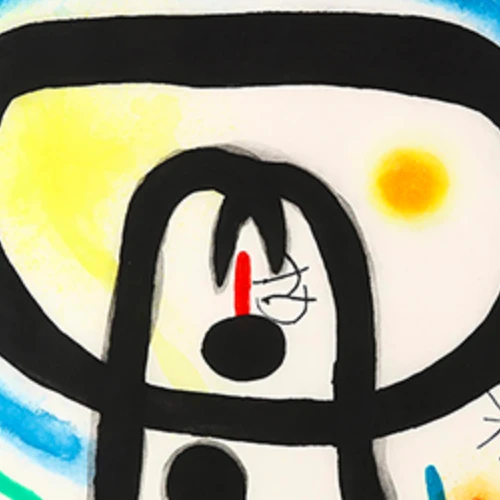
Joan Miró, Équinoxe, 1967, signed etching, aquatint and carborundum, Dupin 428, from an edition of 75.Joan Miró created an extensive body of original prints, but values vary dramatically across his graphic oeuvre.
The strongest auction results tend to favor large-scale, visually powerful works with small editions, important techniques, strong condition and sustained collector demand. Monumental etchings and carborundums from the late 1960s and 1970s are particularly prominent at the upper end of the market.
Works such as Les Grandes manœuvres, Gargantua, Le Permissionnaire and Équinoxe demonstrate how scale, rarity, technique and image quality can combine to produce exceptional prices.
What Are the Most Valuable Joan Miró Prints?
There is no single permanent ranking because different impressions, proofs, portfolios and complete sets come to auction at different times.
However, selected notable public results illustrate the upper end of Miró’s print market:
| Work | Year | Technique | Auction Result |
|---|---|---|---|
| Les Grandes manœuvres | 1973 | Etching, aquatint & carborundum | £75,000 |
| Gargantua | 1977 | Etching, aquatint & carborundum | $75,000 |
| Le Permissionnaire | 1974 | Etching & aquatint | $55,000 |
| La Femme Toupie | 1974 | Etching & aquatint | $47,500 |
| Gargantua | 1977 | Etching, aquatint & carborundum | £48,260 |
| Le Permissionnaire | 1974 | Etching & aquatint | $44,450 |
| Équinoxe | 1967 | Etching, aquatint & carborundum | £38,100 |
| Le Matador | 1969 | Etching, aquatint, drypoint & carborundum | £27,720 |
Methodology: These are selected publicly documented results rather than an exhaustive all-time ranking. Prices are shown in the currency reported by the auction house and generally include buyer’s premium where reported as the price realized.
Why Do These Miró Prints Command High Prices?
The strongest Miró print results share several characteristics.
Les Grandes manœuvres and Gargantua combine monumental scale, small editions and heavily textured late printmaking. Gargantua, for example, measures roughly 63 × 47 inches and was issued in an edition of only 50.
Le Permissionnaire demonstrates that carborundum is not required for a major result. The large etching and aquatint, Dupin 655, was also issued in an edition of 50 and has repeatedly achieved strong prices, including $55,000 at Swann, $43,750 at Phillips and $44,450 at Christie’s.
The common factors are image quality, scale, scarcity, condition, documentation and sustained collector demand.

Joan Miró, La Femme Toupie (The Spinning Woman), 1974, signed etching and aquatint, Dupin 652, edition of 50.Valuable Joan Miró Complete Portfolios
Complete portfolios should be evaluated separately from individual prints. Swann records the complete Passage de l’Égyptienne at $75,000, while Christie’s sold the complete five-print Les Perséides for £35,560 in March 2026.
Intact sets can command strong prices because collectors value completeness, matching edition structure, original cases or folders, justification pages, condition and provenance.
Are Miró Carborundum Prints Among the Most Valuable?
Many of Miró’s strongest individual-print results involve carborundum, particularly large works such as Les Grandes manœuvres, Gargantua and Équinoxe.
The technique allowed Miró to create monumental prints with saturated color and heavily textured surfaces, but carborundum alone does not determine value. Important conventional etchings such as Le Permissionnaire can also command strong prices.
Learn more: Joan Miró Carborundum Prints: A Collector’s Guide →
Rarity, Proofs and Catalogue References
Smaller editions and rare proofs can contribute to value, but rarity alone does not determine price. An important image with sustained demand can outperform a scarcer but less desirable edition.
Artist’s proofs, H.C. impressions, Roman-numeral editions, BATs and other proofs should be evaluated within the documented structure of the specific work rather than assigned an automatic premium.
Comparable sales are most useful when they match the exact Mourlot, Dupin or Cramer reference and edition.
Learn more: Joan Miró Signatures, Edition Numbers & Proofs →
Learn more: Joan Miró Print Catalogue References: Mourlot, Dupin & Cramer →
What Makes a Joan Miró Print Valuable?
The principal factors include:
- Importance and desirability of the image
- Scale
- Technique
- Edition size and rarity
- Signature or proof designation
- Condition and color
- Provenance
- Mourlot, Dupin or Cramer documentation
- Established collector and auction demand
No single characteristic determines value. Rarity, size or technique should always be considered together with the desirability of the specific work.
Buying an Important Joan Miró Print
Before purchasing a higher-value Miró print, confirm the exact title, catalogue reference, medium, dimensions, edition or proof designation, signature, condition and provenance.
Comparable auction results are most useful when they relate to another impression of the same documented edition.
Explore Joan Miró Lithographs, Etchings & Prints for Sale →
Selling a Valuable Joan Miró Print
If you own an important Miró print, photographs of the front and reverse, signature, edition or proof designation, margins and accompanying documentation can help identify the exact edition.
Masterworks Fine Art can review catalogue references, condition, provenance and comparable market results as part of a confidential evaluation.
Request a Confidential Joan Miró Evaluation →
Frequently Asked Questions About Valuable Joan Miró Prints
What is the most valuable Joan Miró print?
There is no permanent all-time ranking, but major publicly documented results include Les Grandes manœuvres, which sold for £75,000 at Phillips, and Gargantua, which sold for $75,000 at Swann. Monumental late etchings and carborundums are particularly prominent at the upper end of Miró’s print market.
How much can a Joan Miró print sell for?
Many Miró prints sell for several thousand dollars, while important large-scale signed editions can reach the tens of thousands. Exceptional individual prints, proofs and complete portfolios can sell higher depending on the work and market.
Are Miró carborundum prints valuable?
Many are. Miró’s large late carborundums are among the most visually powerful and commercially desirable parts of his graphic oeuvre, although technique alone does not determine price.
Are complete Miró portfolios worth more than individual plates?
They can be. Complete portfolios with matching prints, justification pages, texts and original cases are generally scarcer than individual sheets removed from those projects.
Explore More About Joan Miró Prints
Joan Miró Prints for Sale
Explore original Miró lithographs, etchings, aquatints, carborundums and limited editions.
How to Authenticate a Joan Miró Print
Learn how catalogue references, paper, dimensions, signatures, publishers and expert review help identify Miró graphic works.
Joan Miró Signatures, Edition Numbers & Proofs
Understand E.A., P.A., H.C., Roman-numeral editions, BATs and other Miró proof structures.
Joan Miró Print Catalogue References: Mourlot, Dupin & Cramer Numbers Explained
Learn how the primary reference systems identify Miró prints and publications.
Joan Miró Carborundum Prints: A Collector’s Guide
Explore the technique behind many of Miró’s most important late graphic works.
Original Joan Miró Lithograph vs. Poster or Reproduction
Learn how to distinguish original Miró graphics from reproductions and later posters.
Sell a Joan Miró
Own a Joan Miró print or original artwork? Request a confidential evaluation from Masterworks Fine Art.