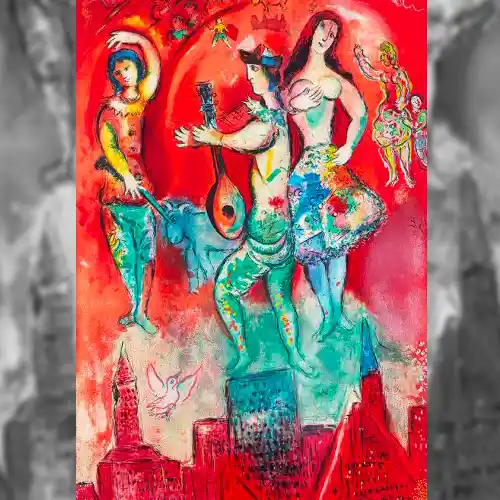
Marc Chagall lithographs were issued in many formats, including signed and numbered editions, artist’s proofs, unsigned book editions, Roman-numeral editions and other proof impressions.
Signature and edition information can help identify exactly which version of a Chagall lithograph you have, but neither should be evaluated alone. They should correspond with the documented specifications for the specific edition.
How Did Marc Chagall Sign His Lithographs?
Many collectible Marc Chagall lithographs were hand-signed in pencil, commonly in the lower right margin.
A typical signed Chagall lithograph may have the artist’s pencil signature on the lower right and an edition number or proof designation on the lower left.
For example, Chagall’s Intimité (Intimacy), 1969 is documented as hand-signed in pencil and numbered from an edition of 50, with an additional group of 25 artist’s proofs numbered in Roman numerals.
The location and appearance of a signature can vary, so collectors should compare the signature with the documented format of the specific edition rather than expecting every authentic Chagall signature to look identical.
Does a Marc Chagall Signature Prove Authenticity?
No. A convincing-looking signature does not establish that the print itself is authentic.
The signature should correspond with the documented catalogue reference, medium, paper, dimensions, edition structure, printer and publisher for the specific work.
Likewise, an unsigned lithograph is not automatically inauthentic; some documented book and portfolio editions were legitimately issued without individual pencil signatures.
Learn more: How to Authenticate a Marc Chagall Lithograph →
Hand-Signed, Printed and Stamped Chagall Signatures
Collectors should distinguish between three very different types of signatures.
- Hand-signed in pencil: Chagall personally signed the individual impression.
- Printed signature: The signature forms part of the printed image and is not a hand signature.
- Stamped signature: May be legitimate when documented for a specific edition, but it is not equivalent to a lifetime pencil signature.
A useful example is Chagall’s Vers l’Autre Clarté (Towards Another Light), 1985. The lithograph was completed during Chagall’s lifetime, while the documented edition was stamp-signed posthumously and bears the dry mark Lithographie originale Atelier Marc Chagall.
The key is not simply whether a signature appears on the sheet, but whether that signature format corresponds with the documented edition.
How Marc Chagall Edition Numbers Work
An edition number such as 12/50 identifies impression 12 from a numbered edition of 50.
A lower number does not generally make an impression more valuable simply because it was numbered earlier. For example, 3/50 is not inherently better or more valuable than 43/50.
The image, edition, signature, proof type, condition, provenance and collector demand are considerably more important.
What Does E.A. Mean on a Marc Chagall Lithograph?

E.A. stands for épreuve d’artiste, the French term for artist’s proof.
Artist’s proofs are impressions produced outside the regular numbered edition and intended historically for the artist’s use or approval.
Chagall’s artist’s proofs may be marked E.A., épreuve d’artiste or numbered as part of a separate artist’s-proof edition. There is no single numbering format that applies to every Chagall artist’s proof.
What Does H.C. Mean on a Chagall Lithograph?

H.C. means hors commerce, French for “not for sale.” These proofs were traditionally reserved outside the commercial numbered edition for the artist, publisher, printer or collaborators.
An H.C. designation does not automatically make a Chagall lithograph more valuable. Its desirability depends on the specific work, rarity, condition and provenance.
What Do Roman Numerals Mean on a Chagall Print?
Roman numerals can identify a separate edition or group of proofs, but they do not always mean the same thing.
For example:
| Marking | Possible meaning |
|---|---|
| XV/XXV | Impression 15 from a group of 25 proofs |
| I/XXV–XXV/XXV | Separate edition of 25 in Roman numerals |
| E.A. XV/XXV | Numbered artist’s proof |
| H.C. | Hors commerce proof |
| Épreuve de collaborateur | Collaborator’s proof |
The exact meaning must be checked against the catalogue entry for that particular Chagall lithograph.
Chagall’s Au-dessus de Paris (Over Paris), 1970, for example, is documented with an edition of 50 signed and numbered in Arabic numerals and an additional edition of four signed and numbered in Roman numerals identified as collaborator proofs.
Can the Same Chagall Lithograph Exist in Different Editions?
Yes. The same image can exist in different documented editions.
Certain Daphnis et Chloé lithographs, for example, were issued in a signed and numbered edition of 60 with wide margins, while an unsigned book edition of 250 was also produced.
Both may be authentic original Chagall lithographs, but they are different editions and should not be described or valued as though they were identical.
Are Artist’s Proofs More Valuable Than Numbered Chagall Lithographs?
Not automatically. Artist’s proofs may be scarcer, but an E.A. or H.C. designation alone does not guarantee a premium. Value depends on the image, edition, signature, condition, provenance and collector demand.
Learn more: Marc Chagall Lithograph Values & Prices →
Are Unsigned Marc Chagall Lithographs Authentic?
Some are. Chagall produced original lithographs for books, portfolios and publications in which the individual impressions were not hand-signed.
Daphnis et Chloé is an important example: documented unsigned book impressions exist alongside signed limited-edition impressions.
The correct question is not simply whether a signature is present, but whether that particular edition was documented as signed or unsigned.
Signature, numbering and proof designations should correspond with the documented catalogue entry for the specific Chagall lithograph.
Mourlot, Sorlier and Cramer references can help establish the known edition and proof structure, including whether documented impressions were signed or unsigned.
Learn more: Marc Chagall Catalogue Raisonné: Mourlot, Sorlier & Cramer Print References →
Red Flags in Chagall Signatures and Edition Numbers
Warning signs can include:
- Printed signature represented as hand-signed
- Numbering inconsistent with the documented edition
- Hand signature on an edition documented as unsigned
- E.A., H.C. or proof designation inconsistent with the catalogue entry
- Paper or dimensions inconsistent with the edition
- Documentation used to explain material discrepancies in the physical work
A discrepancy does not automatically establish that a work is inauthentic, but inconsistencies should be researched against the documentation for the exact edition.
Buying a Signed Marc Chagall Lithograph
Before purchasing a signed Chagall lithograph, identify the exact work and confirm its catalogue reference, documented signature format, edition size or proof designation, paper, dimensions, printer, publisher, condition and provenance.
Do not rely on the presence of a pencil signature alone.
Explore Marc Chagall Lithographs for Sale →
Selling or Evaluating a Signed Marc Chagall Lithograph
If you own a signed, numbered or proof Chagall lithograph, useful photographs include the entire work, signature, edition or proof inscription, reverse, margins, blindstamps and existing documentation.
Masterworks Fine Art can review the work’s catalogue references, edition information, signature, condition and provenance as part of a confidential evaluation.
Request a Confidential Marc Chagall Evaluation →
Frequently Asked Questions About Marc Chagall Signatures and Editions
Where did Marc Chagall usually sign his lithographs?
Many signed Chagall lithographs carry a pencil signature in the lower right margin, although the format should always be checked against the documentation for the individual edition.
Does a lower edition number make a Chagall lithograph more valuable?
Generally, no. An impression numbered 3/50 is not inherently more valuable than 43/50. The total edition, image, signature, condition, rarity and demand are more important.
What does E.A. mean on a Chagall lithograph?
E.A. means épreuve d’artiste, or artist’s proof. These impressions exist outside the regular numbered edition and may themselves be unnumbered or numbered as a separate proof edition.
What does H.C. mean on a Chagall lithograph?
H.C. means hors commerce. These proofs were traditionally reserved outside the commercial edition for purposes associated with the artist, publisher, printer or collaborators.
Can an authentic Chagall lithograph be unsigned?
Yes. Some original Chagall lithographs, particularly works produced for illustrated books and portfolios, were legitimately issued unsigned. The signature format should be checked against the documentation for the exact edition.