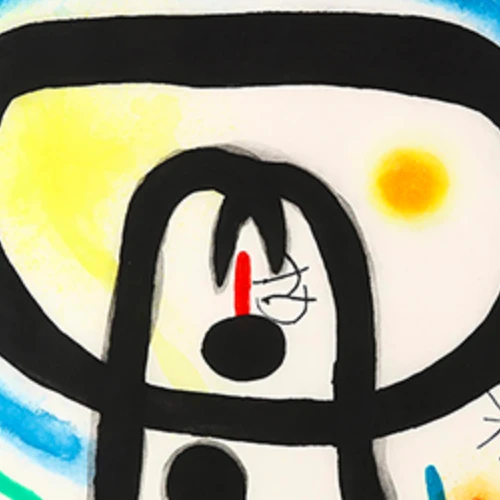
Joan Miró, L’Exile Vert (The Green Exile), 1969, hand-signed in pencil and annotated E.A. as an artist’s proof.Joan Miró prints can carry a wide range of signatures, edition numbers and proof designations.
Many were hand-signed and numbered in pencil, but documented editions can also include E.A., P.A., H.C., Roman-numeral editions, bon à tirer (BAT), trial proofs, working proofs, initials or other inscription formats.
The important question is not whether every Miró print follows one standard format, but whether its signature, numbering and proof designation correspond with the documented edition for that specific work.
How Did Joan Miró Sign His Prints?
A common format is a pencil signature in the lower right margin, with the edition number or proof designation toward the lower left.
However, this is not universal. Depending on the documented edition, Miró prints may be:
- Hand-signed
- Initialed or monogrammed
- Unsigned as issued
- Accompanied by special proof inscriptions
- Issued in separately numbered proof groups
For example, Christie’s documents Album 19: One Plate, Mourlot 314, as signed with Miró’s monogram and annotated H.C., with an edition of 75 in Arabic numerals plus 15 in Roman numerals.
The signature format and placement should always be checked against the specific edition.
Does a Joan Miró Signature Prove Authenticity?
No.
A convincing signature does not independently authenticate the underlying print. The signature and edition information should correspond with the documented medium, paper, dimensions, printer, publisher and catalogue reference for that specific work.
Learn more: How to Authenticate a Joan Miró Print →
Can a Miró Print Be Initialed, Stamped or Unsigned?
Yes, depending on the documented edition—but these terms must be used precisely.
- Hand-signed means Miró individually signed the impression.
- Initialed or monogrammed means the documented inscription uses initials rather than his full signature.
- Stamped signature is mechanically applied and is not equivalent to a hand signature.
- Unsigned as issued means no individual signature was required for that edition.
Some later or posthumously published Miró-related editions also carry stamped signatures or succession authentication marks. These should be described according to their exact publication history rather than presented simply as “signed Miró prints.”
The catalogue documentation for the specific work determines which format is appropriate.
How Do Joan Miró Edition Numbers Work?
A conventional number such as:
27/75
means impression 27 from a regular numbered edition of 75.
This is different from a catalogue reference such as Mourlot 491 or Dupin 716. The catalogue number identifies the documented work; the fraction identifies an impression within the edition.
Does a Lower Edition Number Make a Miró Print More Valuable?
Generally, no. An impression numbered 2/75 is not inherently more valuable than 62/75 simply because its number is lower.
Edition numbers should not be assumed to represent printing order unless specific documentation says otherwise. Image, condition, rarity, provenance and collector demand generally matter much more.
Joan Miró Proof Types at a Glance
| Marking | Meaning |
|---|---|
| 27/75 | Impression 27 from the regular edition of 75 |
| E.A. | Épreuve d’artiste — Artist’s Proof |
| A.P. | Artist’s Proof |
| P.A. | Prueba de artista — Artist’s Proof |
| H.C. | Hors commerce — outside the regular commercial edition |
| III/XV | Impression 3 from a separate Roman-numeral edition of 15 |
| B.A.T. / BAT | Bon à tirer — approved proof used as the printing standard |
| Trial Proof | Developmental proof made before the final edition |
| Working Proof | Proof used during creation or correction of the image |
The exact meaning of any inscription should be checked against the catalogue documentation for the specific Miró work.
What Do E.A., P.A., H.C. and Roman Numerals Mean?

Joan Miró, La Dame aux damiers, 1969, hand-signed lithograph annotated E.A. as an artist’s proof.E.A. — Épreuve d’artiste
E.A. means épreuve d’artiste, or artist’s proof. These impressions exist outside the regular numbered edition.
P.A. — Prueba de artista
P.A. is the Spanish equivalent of artist’s proof and may also appear on documented Miró editions.
H.C. — Hors commerce
H.C. means hors commerce, or outside commerce. It identifies impressions outside the regular commercial edition.
H.C. and E.A. are not technically the same designation.
Roman Numerals
Roman numerals such as III/XV usually identify a separately numbered edition or proof group. They do not automatically mean artist’s proof.
For example, Album 19: One Plate, Mourlot 314, had 75 impressions numbered in Arabic numerals plus 15 numbered in Roman numerals.
Both can exist outside the regular edition, but E.A. specifically identifies an artist’s proof, while H.C. identifies a hors commerce impression.
Can the Same Miró Print Exist in Several Editions?
Yes.
A single Miró image may exist as a regular numbered edition alongside:
- Roman-numeral editions
- E.A. or P.A. artist’s proofs
- H.C. impressions
- Wide-margin editions
- Alternate paper editions
- Book or portfolio editions
- Trial, working or BAT proofs
For example, Masterworks documents Miró Lithographs I, 1972, Mourlot 857, with a regular edition of 150, a separate wide-margin edition of 80 numbered in Roman numerals and H.C. impressions.
This is why an “edition of 150” may describe only the regular numbered edition rather than every documented impression from the project.

BAT, Trial and Working Proofs
A bon à tirer (BAT) is the approved proof used as the standard for printing the final edition. BAT impressions can preserve Miró’s handwritten corrections or instructions to the printer.
Christie’s documents a Miró lithograph from Joan Miró Lithographe III signed, dated and inscribed “Bat après correction,” with Miró’s own instructions for changes to the composition.
Christie’s also documents BAT proofs from Joan Miró. Gravats 5 Poemes carrying Miró’s instructions to the printer before the regular edition.
A trial proof records an earlier state before the image is finalized, while a working proof may carry alterations, annotations or other evidence of the creative process.
These proofs can be extremely scarce and historically important, but their significance depends on the individual work, documentation and provenance.
Are Joan Miró Artist’s Proofs More Valuable?
Not automatically.
An E.A., H.C., BAT, trial or working proof may be scarcer than a regular numbered impression, but the designation alone does not guarantee a premium.
Value depends on the:
- Importance of the image
- Rarity of the proof
- Miró annotations or corrections
- Condition
- Provenance
- Catalogue documentation
- Collector demand
A unique BAT carrying Miró’s handwritten instructions may occupy a very different market from an ordinary artist’s proof, but unusual proofs should not simply be valued by applying a fixed percentage premium.
Learn more: Most Valuable Joan Miró Prints & Editions →
Why Catalogue References Matter
Miró proof designations become meaningful only after the exact work has been identified.
The principal references include:
- Mourlot / M. — lithographs
- Dupin / D. — etchings, aquatints, carborundums and related intaglio works
- Cramer — illustrated books and publications
The catalogue entry can establish whether a work includes regular numbered impressions, artist’s proofs, H.C. impressions, Roman-numeral editions or other proof groups.
Learn more: Joan Miró Print Catalogue References: Mourlot, Dupin & Cramer Numbers Explained →
Red Flags in Miró Signatures and Edition Numbers
Potential warning signs include:
- Printed or stamped signature represented as hand-signed
- Signature format inconsistent with the documented edition
- Edition number inconsistent with the catalogue
- E.A., P.A. or H.C. notation not documented for the work
- Roman-numeral edition interpreted incorrectly
- Ordinary impression represented as BAT, trial or unique proof
- Paper or dimensions inconsistent with the documented edition
- Certificate or seller description conflicting with the physical print
A single discrepancy does not automatically establish inauthenticity, but significant inconsistencies should be researched against the documentation for the exact edition.
Buying a Signed Joan Miró Print
Before purchasing, confirm the exact title, catalogue reference, signature format, edition or proof designation, medium, dimensions, paper, condition and provenance.
Do not assume that an E.A. is automatically better than a numbered impression or that a lower edition number is inherently more valuable.
Explore Joan Miró Lithographs, Etchings & Prints for Sale →
Selling or Evaluating a Joan Miró Proof
If you own a Miró marked E.A., P.A., H.C., BAT, with Roman numerals or another unusual proof designation, photographs of the full sheet, signature, inscriptions, reverse and accompanying documentation can help identify the exact edition.
Masterworks Fine Art can review the applicable catalogue reference, edition structure, condition and provenance as part of a confidential evaluation.
Request a Confidential Joan Miró Evaluation →
Frequently Asked Questions About Joan Miró Signatures and Editions
Where does Joan Miró usually sign his prints?
Many signed Miró prints carry a pencil signature in the lower right and edition or proof notation toward the lower left, but placement varies by edition.
What does E.A. mean on a Miró print?
E.A. means épreuve d’artiste, or artist’s proof, identifying an impression outside the regular numbered edition.
What does H.C. mean on a Joan Miró print?
H.C. means hors commerce, identifying an impression outside the regular commercial edition. It is not technically the same designation as an E.A. artist’s proof.
What does BAT mean on a Miró print?
BAT means bon à tirer, the approved proof used as the standard for printing the edition. Some Miró BATs contain handwritten corrections or instructions.
What do Roman numerals mean on a Miró print?
Roman numerals generally identify a separately numbered edition or proof group. Their exact meaning depends on the documented edition.
Does a lower edition number make a Joan Miró print more valuable?
Generally, no. A print numbered 3/75 is not inherently more valuable than 63/75 simply because the number is lower.
Explore More About Joan Miró Prints
Joan Miró Prints for Sale
Explore original Miró lithographs, etchings, aquatints, carborundums and limited editions.
Most Valuable Joan Miró Prints & Editions
Explore important Miró graphic works and significant public auction results.
How to Authenticate a Joan Miró Print
Learn how catalogue references, paper, dimensions, signatures, publishers and provenance help identify original Miró graphic works.
Joan Miró Print Catalogue References: Mourlot, Dupin & Cramer
Learn how the primary reference systems identify Miró lithographs, etchings, portfolios and illustrated works.
Original Joan Miró Lithograph vs. Poster or Reproduction
Learn how original Miró graphic editions differ from lithographic posters and later reproductions.
Joan Miró Carborundum Prints: Technique, Value & Collecting
Explore Miró’s heavily textured carborundum technique and important late graphic works.
Sell a Joan Miró Artwork
Own a Joan Miró print, proof or other original artwork? Request a confidential evaluation from Masterworks Fine Art.