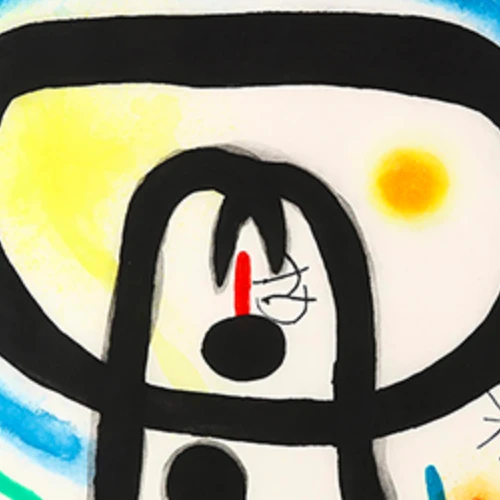
Collectors researching Joan Miró prints frequently encounter references such as Mourlot 452, Dupin 708 or Cramer 187.
These are catalogue raisonné references, not edition numbers. They identify documented works or publication projects within Miró’s extensive graphic oeuvre.
In general, Mourlot is used for lithographs, Dupin for etchings and related intaglio works, and Cramer for illustrated books and publication projects. A single Miró print can legitimately carry more than one catalogue reference.
What Is a Joan Miró Catalogue Raisonné Number?
A catalogue raisonné number is a scholarly reference identifying a documented work or project.
A catalogue entry can help establish the work's title, date, medium, dimensions, paper, edition structure, printer, publisher and publication history.
It is different from an edition number:
Mourlot 452 = catalogue reference for the documented lithograph
27/75 = impression 27 from a regular edition of 75
Browse the Joan Miró Catalogue Raisonné →
What Is a Mourlot Number?
A Mourlot or M. number is the principal catalogue reference commonly used for Joan Miró lithographs.
The six-volume Joan Miró Lithographe catalogue documents Miró’s lithographic work from 1930 through 1981. The complete series consists of six volumes, with Fernand Mourlot associated with the earlier volumes and Patrick Cramer with volumes V and VI.
Auction and gallery descriptions may show:
Mourlot 452
or
M. 452
These refer to the same catalogue-numbering system.
For example, Cartones, 1965, is documented as Mourlot 452.
Some records refer to Maeght-published volumes, but Mourlot / M. is the standard terminology commonly encountered in auction and collector research. Maeght is important as a publisher of both the catalogue and many Miró prints, rather than as a separate catalogue-numbering system.
What Is a Dupin Number?
A Dupin or D. number is the principal catalogue reference used for Miró’s etchings, aquatints, carborundums and related intaglio works.
These works are documented in Jacques Dupin’s Miró Graveur catalogue raisonné.
A listing may therefore show:
Dupin 708
or
D. 708
For example, Composition from L’issue dérobée, 1974, is documented as Dupin 708 and also Cramer 187 because the individual etching belongs to an illustrated-publication project.
What Is a Cramer Number on a Joan Miró Print?
Patrick Cramer’s Joan Miró: The Illustrated Books documents Miró’s illustrated books, albums and catalogues. Published in 1989, it catalogues approximately 262 publication projects.
For example:
Mourlot 412 → identifies an individual lithograph from Ubu Roi
Cramer Books 107 → identifies the related illustrated-book project
A Cramer number does not necessarily identify an individual sheet. Several lithographs within the same publication can have different Mourlot numbers while sharing the same Cramer publication reference.
Why Can One Miró Print Have Two Catalogue Numbers?

One Miró print can carry two catalogue references because different catalogues document different aspects of the same work.
A lithograph appearing within an illustrated book may have:
one Mourlot number
plus:
one Cramer Books number
An etching or aquatint associated with an illustrated publication may have:
one Dupin number
plus:
one Cramer number
This is completely normal.
Examples include:
| Miró Work | Individual Print Reference | Publication Reference |
|---|---|---|
| Suites pour Ubu Roi: Plate XXI | Mourlot 412 | Cramer Books 107 |
| El vol de l’alosa, 1973 | Mourlot 924 | Cramer Books 170 |
| Composition from L’issue dérobée, 1974 | Dupin 708 | Cramer 187 |
| Hommage à San Lazzaro, Pl. 7, 1977 | Dupin 984 | Cramer 229 |
Sotheby’s, Christie’s and Masterworks routinely use this type of dual cataloguing.
Mourlot vs. Dupin vs. Cramer at a Glance
| Reference | Primarily Used For | Common Abbreviation |
|---|---|---|
| Mourlot | Miró lithographs | M. |
| Dupin | Etchings, aquatints, carborundums and related intaglio works | D. |
| Cramer | Illustrated books, albums, catalogues and related projects | Cramer Books / C. Books |
A useful first rule is:
Lithograph → start with Mourlot
Etching / aquatint / carborundum → start with Dupin
Book or portfolio project → also check Cramer
Some works require more than one reference.
Catalogue Number vs. Edition Number
Collectors frequently confuse these.
Suppose an auction description says:
El vol de l’alosa, 1973 — Mourlot 924; Cramer Books 170 — VIII/XV
These three references tell you three different things.
Mourlot 924
Identifies the lithographic work.
Cramer Books 170
Identifies its illustrated publication context.
VIII/XV
Identifies the individual impression as number eight from a Roman-numeral group of fifteen.
Sotheby’s documents precisely this type of dual reference and edition structure for El vol de l’alosa.
A catalogue number should therefore never be confused with an inscription appearing physically on the sheet.
Does a Mourlot, Dupin or Cramer Number Prove Authenticity?
No.
A catalogue reference identifies the documented work or project; it does not authenticate the individual physical impression.
The print should still correspond with the documented technique, paper, dimensions, signature, edition structure, printer and publisher.
Learn more: How to Authenticate a Joan Miró Print →
How to Research a Joan Miró Catalogue Number
Start with the printing technique:
Lithograph
Check Joan Miró Lithographe for the appropriate Mourlot / M. number.
Etching, aquatint or carborundum
Check Jacques Dupin’s Miró Graveur for the appropriate Dupin / D. number.
Book, album, catalogue or publication project
Also check Patrick Cramer’s Joan Miró: The Illustrated Books.
Then compare the documented image, date, medium, paper, dimensions, edition structure, signature, printer and publisher with the physical work.

Common Mistakes With Joan Miró Catalogue Numbers
- Confusing a Mourlot or Dupin number with an edition number
- Assuming Cramer always identifies one individual sheet
- Assuming two catalogue references indicate two different works
- Comparing prices without matching the exact catalogue reference
- Using a Cramer project number to distinguish individual plates
- Expecting every lithograph to have a Dupin number or every etching to have a Mourlot number
- Relying on copied online descriptions without checking the relevant catalogue
The key is to identify which catalogue is being cited and what that catalogue is designed to document.
Buying a Joan Miró Print
Before purchasing a Miró print, ask for the applicable Mourlot, Dupin and/or Cramer reference and confirm that the physical work corresponds with the documented edition.
Explore Joan Miró Lithographs, Etchings & Prints for Sale →
Selling or Identifying a Joan Miró Print
If you own a Miró and do not know its catalogue reference, photographs of the full front and reverse, signature, edition or proof designation, margins and any existing documentation can help identify the work.
Masterworks Fine Art can compare these details with the appropriate catalogue references as part of a confidential evaluation.
Request a Confidential Joan Miró Evaluation →
Frequently Asked Questions About Joan Miró Catalogue References
What does M. mean on a Joan Miró print?
M. generally refers to the Mourlot catalogue number used to identify a documented Miró lithograph. For example, M. 452 means Mourlot 452.
What does D. mean on a Joan Miró print?
D. generally means Dupin, the principal catalogue reference for Miró’s etchings, aquatints, carborundums and other engraved works.
What is a Cramer Books number?
A Cramer Books reference identifies a Miró illustrated book, album, catalogue or related publication documented in Patrick Cramer’s catalogue raisonné. Individual prints within the publication can have separate Mourlot or Dupin references.
Can a Joan Miró print have two catalogue numbers?
Yes. A lithograph associated with an illustrated publication can carry both a Mourlot and Cramer reference, while an etching or aquatint can carry both a Dupin and Cramer reference. The individual-print reference and publication reference identify different aspects of the same work.
Is a Mourlot number the same as an edition number?
No. Mourlot identifies the documented lithograph. A fraction such as 27/75 identifies an individual impression within a numbered edition.
Does a catalogue raisonné number prove a Miró print is authentic?
No. It identifies the documented work or edition. The physical impression must still correspond with the catalogue specifications.
Browse the Joan Miró Catalogue Raisonné →
Explore More About Joan Miró Prints
Joan Miró Prints for Sale
Explore original Miró lithographs, etchings, aquatints, carborundums and limited editions.
How to Authenticate a Joan Miró Print
Learn how catalogue references, signatures, paper, dimensions and the official Fundació authentication process help identify original Miró graphic works.
Joan Miró Signatures, Edition Numbers & Proofs
Understand E.A., P.A., H.C., Roman numerals, BATs, trial proofs and other Miró edition structures.
Most Valuable Joan Miró Prints & Editions
Explore important Miró graphic works, portfolios and significant public auction results.
Original Joan Miró Lithograph vs. Poster or Reproduction
Learn how to distinguish an original Miró graphic work from reproductions, book plates and later posters.
Joan Miró Carborundum Prints: Technique, Value & Collecting
Explore Miró’s experimental carborundum technique, important works and collector market.
Sell a Joan Miró Artwork
Own a Joan Miró print or original artwork? Request a confidential evaluation from Masterworks Fine Art.