How to Authenticate a Joan Miró Print
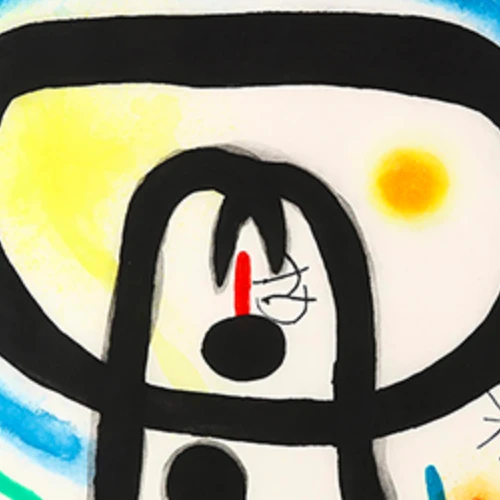
Joan Miró’s carborundum prints are among the most visually powerful and technically distinctive works in his graphic oeuvre.
Beginning in 1967, Miró combined carborundum with techniques such as etching, aquatint and drypoint to create dense blacks, saturated color and heavily textured surfaces that could approach the physical presence of painting.
The technique became central to Miró’s late printmaking and produced major works including Équinoxe, Le Grand Sorcier, La Fronde, Les Grandes Manœuvres and Gargantua. Christie’s has described these late carborundums as the culmination of his graphic work.
What Is a Carborundum Print?
Carborundum is the common name for silicon carbide, an extremely hard abrasive material.
In printmaking, powdered carborundum is mixed with a binding material and applied to a printing plate. Its rough surface holds substantial amounts of ink and, when printed under pressure, can create:
- Dense, velvety blacks
- Rich fields of color
- Granular texture
- Strong tonal variation
- Physical relief or embossing in the paper
The result can look and feel substantially different from a conventional flat lithograph.
When Did Joan Miró Begin Using Carborundum?
Miró began working seriously with carborundum in 1967, when printer Robert Dutrou introduced him to the silicon-carbide technique developed by painter and printmaker Henri Goetz.
Working at Saint-Paul-de-Vence in southern France, Miró quickly adopted the process because it allowed him to work more directly while creating unusually rich surfaces.
His carborundums from the late 1960s established the monumental scale, saturated color and heavily textured black forms that became hallmarks of his mature printmaking.
Why Was Carborundum Important to Miró?
Carborundum gave Miró greater freedom than many traditional printmaking processes. He could combine etching for line, aquatint for areas of color and carborundum for texture and depth within the same image.
Because the rough carborundum surface holds significant quantities of ink, heavily worked areas can appear dense, granular and almost three-dimensional. Printing pressure can also create physical relief in the paper.
This combination helped Miró produce monumental prints with a surface presence unusually close to painting—one reason his late carborundums are regarded as a major development in his graphic work.
Are Joan Miró Carborundums Original Prints?
Yes, when they belong to a documented original edition.
Carborundum is a printmaking technique, not a reproductive process. Miró commonly combined it with other intaglio techniques, so a work may be catalogued as:
- Etching, aquatint and carborundum
- Etching, aquatint, drypoint and carborundum
For example, Le Grand Sorcier, 1968, is documented as an etching, aquatint, drypoint and carborundum, Dupin 453, from a hand-signed edition of 75.
The exact technique should correspond with the catalogue entry for the individual work.
How Are Joan Miró Carborundum Prints Catalogued?
Miró’s carborundums and other intaglio prints are primarily documented in Jacques Dupin’s Miró Graveur and are commonly identified by a Dupin or D. number.
Examples include:
- Le Grand Sorcier, 1968 — Dupin 453
- La Biche Chantant la Tosca, 1969 — Dupin 485
- La Fronde, 1969 — Dupin 501
- Le Grand Ordonnateur, 1969 — Dupin 503
- La Sorcière, 1969 — Dupin 519
Unlike Miró lithographs, which are generally identified with Mourlot references, carborundum works typically fall within the Dupin numbering system.
The exact Dupin reference is important when identifying, authenticating or comparing prices for a Miró carborundum.

Browse the Joan Miró Catalogue Raisonné →
Important Joan Miró Carborundum Prints
| Work | Year | Dupin | Notable Characteristics |
|---|---|---|---|
| Équinoxe | 1967 | D. 428 | Early monumental carborundum; Mandeure rag paper |
| Le Grand Sorcier | 1968 | D. 453 | Etching, aquatint, drypoint and carborundum; edition 75 |
| La Biche Chantant la Tosca | 1969 | D. 485 | Large-format color carborundum |
| La Fronde | 1969 | D. 501 | Strong textured black passages; edition 75 |
| La Sorcière | 1969 | D. 519 | Monumental format; aquatint, etching and carborundum |
| Barcelona 1972–1973 XI | 1973 | D. 602 | From the 13-print Barcelona 1972–1973 series |
| Les Grandes Manœuvres | 1973 | D. 575 | Tall monumental format; edition 50 |
| Gargantua | 1977 | D. 972 | Monumental late carborundum approximately 63 × 47 inches |
Miró’s carborundums range from the first major experiments of 1967–1968 to increasingly ambitious works of the 1970s. Many were issued in relatively small editions of 50 or 75 and can reach substantial scale.
The combination of large sheets, saturated color and deeply textured passages gives the strongest examples a wall presence closer to paintings than to traditionally intimate works on paper.

Are Joan Miró Carborundum Prints Valuable?
Important examples can be highly valuable, particularly monumental, hand-signed works with strong imagery and established auction histories.
Value typically depends on:
- Image and importance of the work
- Scale
- Edition size and rarity
- Signature and proof designation
- Condition
- Provenance
- Dupin documentation
- Collector demand
Carborundum itself does not automatically make a Miró print valuable. A highly desirable lithograph may be worth more than a less important carborundum.
Recent results illustrate the market for major examples: Christie’s sold Équinoxe, 1967, for £38,100 and Gargantua, 1977, for £48,260 on March 26, 2026.
Learn more: Most Valuable Joan Miró Prints & Editions →
Are Joan Miró Carborundum Prints Hand-Signed?
Many important limited-edition Miró carborundums were hand-signed in pencil, but signature and numbering formats vary by edition.
The signature should correspond with the documented work and does not by itself establish authenticity.
Learn more: Joan Miró Signatures, Edition Numbers & Proofs →
How Can You Recognize a Miró Carborundum?
Carborundum passages can show characteristics not normally present in a flat lithograph, including:
- Granular or sandy texture
- Dense, velvety areas of ink
- Physical relief or depressions in the paper
- Heavily saturated passages
- Irregular tactile edges
Miró often combined several printing techniques in one work, so some areas may remain relatively flat while others are heavily textured.
Photographs can suggest carborundum, but ordinary lighting may flatten the surface visually. For identification, detailed images taken under directional or raking light can help reveal relief and surface texture.
Condition and Framing of Miró Carborundum Prints
Condition is especially important because carborundum can create a physically pronounced printed surface.
Collectors should look for creasing, abrasion, surface loss, disturbed textured areas, foxing, staining, fading, trimming and poor previous mounting.
The printed surface should generally not rest directly against glazing. Archival framing with adequate separation helps protect heavily textured passages from compression or abrasion.
For significant works, conservation and framing decisions should be made with an experienced fine-art framer or paper conservator.
Joan Miró Carborundum vs. Lithograph
| Carborundum | Lithograph |
|---|---|
| Intaglio-related technique using abrasive material on a plate | Planographic printing process |
| Can create substantial texture and physical relief | Generally produces a flatter printed surface |
| Miró references usually documented in Dupin | Miró references usually documented in Mourlot |
| Often combined with etching and aquatint | Printed from stone or lithographic plate |
| Especially important in Miró’s late 1960s–1970s work | Used extensively throughout Miró’s printmaking career |
Neither technique is inherently more valuable. Value depends on the specific work, image, rarity, condition and collector demand.
How to Research a Joan Miró Carborundum
Begin by identifying the exact Dupin reference, then compare the physical work with the documented:
- Technique
- Sheet and image dimensions
- Paper
- Edition and proof structure
- Signature
- Printer and publisher
- Surface characteristics
- Provenance
A catalogue number identifies the documented work but does not independently authenticate the physical impression.
Learn more: How to Authenticate a Joan Miró Print →
Red Flags in a Questionable Miró Carborundum
Potential warning signs include:
- A flat reproduction represented as textured carborundum
- Incorrect Dupin reference
- Wrong dimensions or paper
- Edition information inconsistent with the catalogue
- Printed signature represented as hand-signed
- Missing expected carborundum texture
- Incorrect printer or publisher
- Significant unexplained trimming or altered margins
A single discrepancy does not automatically establish that a work is inauthentic, but significant inconsistencies should be investigated against the documentation for the exact edition.
Buying a Joan Miró Carborundum Print
Before purchasing an important Miró carborundum, confirm the exact title, Dupin reference, technique, dimensions, paper, edition or proof designation, signature, printer or publisher, condition and provenance.
For higher-value works, detailed photographs showing the textured surface under directional light can be particularly useful.
Explore Joan Miró Lithographs, Etchings & Prints for Sale →
Selling a Joan Miró Carborundum Print
If you own a Miró carborundum, photographs of the front and reverse, signature, edition or proof designation, margins, textured areas, watermarks, labels and existing documentation can help identify the work.
Masterworks Fine Art can review the applicable Dupin reference, edition structure, condition, provenance and comparable market information as part of a confidential evaluation.
Request a Confidential Joan Miró Evaluation →
Frequently Asked Questions About Joan Miró Carborundum Prints
What is a Joan Miró carborundum print?
It is an original print made using silicon-carbide abrasive material applied to a printing plate, typically combined by Miró with techniques such as etching and aquatint to create dense color and highly textured surfaces.
When did Joan Miró start using carborundum?
Miró began working seriously with carborundum in the late 1960s after printer Robert Dutrou introduced him to the technique in 1967.
Are Joan Miró carborundums original prints?
Yes, documented Miró carborundum editions are original graphic works. Carborundum is a printmaking technique rather than a reproductive printing process.
Are Joan Miró carborundum prints valuable?
Important examples can be highly valuable. Large-scale works such as Gargantua and Équinoxe have produced strong public auction results, although value depends on the exact work, edition, condition, signature, rarity and demand.
What catalogue identifies Joan Miró carborundum prints?
Miró carborundums are primarily documented in Jacques Dupin’s Miró Graveur and are generally identified by a Dupin or D. number.
How can I identify a Joan Miró carborundum?
Identify the exact Dupin reference and compare the physical technique, dimensions, paper, signature, edition, printer and publisher with the documented work. Formal authentication requires examination of the individual object.
Explore More About Joan Miró Prints
Joan Miró Prints for Sale
Explore original Miró lithographs, etchings, aquatints and limited editions.
Most Valuable Joan Miró Prints & Editions
Explore major auction results and the characteristics associated with high-value Miró prints.
How to Authenticate a Joan Miró Print
Learn how catalogue references, paper, dimensions, signatures, publishers and provenance help identify original Miró prints.
Joan Miró Signatures, Edition Numbers & Proofs
Understand E.A., P.A., H.C., Roman-numeral editions and other Miró proof designations.
Joan Miró Print Catalogue References: Mourlot, Dupin & Cramer
Learn how the principal catalogues identify Miró lithographs, etchings, carborundums and illustrated books.
Original Joan Miró Lithograph vs. Poster or Reproduction
Learn how original graphic works differ from original lithographic posters and later reproductions.
Sell a Joan Miró
Own a Joan Miró print or original artwork? Request a confidential evaluation from Masterworks Fine Art.