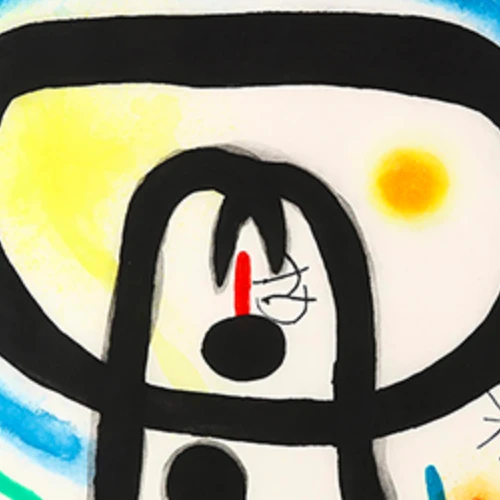
Joan Miró, Maravillas con Variaciones Acrósticas en El Jardín de Miró, Plate 9, 1975, signed lithograph, Mourlot 1059 and Cramer 211.Authenticating a Joan Miró print begins with identifying the exact documented edition, not simply recognizing the image or signature.
Miró worked extensively in lithography, etching, aquatint, drypoint, carborundum and illustrated books, often with multiple editions and proof structures.
A convincing identification should bring the physical work into agreement with its catalogue reference, technique, paper, dimensions, signature, edition structure, printer, publisher and provenance.
Identify the Exact Joan Miró Print
Before evaluating a signature or edition number, identify the exact work.
For Miró prints, the principal catalogue references include:
- Mourlot / M. — lithographs
- Dupin / D. — etchings, aquatints, carborundums and related intaglio works
- Cramer — illustrated books and portfolio projects
For example, Maravillas con Variaciones Acrósticas en El Jardín de Miró, Plate 9, 1975, is documented as Mourlot 1059 and Cramer 211, a color lithograph on Arches paper from an edition of 75.
A catalogue number identifies the documented work or edition; it does not independently authenticate the physical sheet.
The key question is:
Does the physical work correspond with the specifications documented for that catalogue entry?
Browse the Joan Miró Catalogue Raisonné →
Check the Signature and Edition Structure
Many Miró prints were hand-signed in pencil, but authentic editions can also be initialed, unsigned as issued, or carry documented proof designations.
Check whether the work's:
- Signature format
- Signature placement
- Edition number
- E.A., H.C. or other proof designation
- Roman-numeral or alternate edition
correspond with the catalogue documentation for that specific work.
A convincing signature does not authenticate an incorrect print, and an unsigned impression is not automatically a reproduction.
Learn more: Joan Miró Signatures, Edition Numbers & Proofs →
Check the Paper, Watermarks and Dimensions
Paper and dimensions can provide important identifying evidence.
Miró editions were printed on documented supports including Arches, Rives, Guarro and Japon papers, among others. Some works also carry identifiable watermarks.
Compare the work's:
- Paper
- Watermark, where documented
- Image dimensions
- Sheet dimensions
- Margins and sheet edges
with the catalogue entry for the exact edition.
A watermark alone does not authenticate a print, and its position may vary. Likewise, minor dimensional differences can result from measurement methods or natural changes in paper.
However, materially incorrect paper or substantially different dimensions warrant further research.
Confirm the Printing Technique
The physical work should correspond with the documented printing process.
A work catalogued as an etching and aquatint should not physically resemble an offset reproduction, while Miró’s carborundums can show pronounced texture that differs substantially from a flat commercial print.
The declared medium should make sense when compared with both the physical object and its catalogue documentation.
Learn more: Joan Miró Carborundum Prints: Technique, Value & Collecting →
Check the Printer, Publisher and Workshop Marks
Miró worked with important printers and publishers including Mourlot, Maeght, Arte Adrien Maeght, Morsang, Ediciones Polígrafa, Sala Gaspar and Tériade.
Some editions also carry documented:
- Publisher blindstamps
- Workshop marks
- Paper watermarks
- Portfolio inscriptions
For example, Femme, Lune, Étoile, 1963, carries a documented Maeght blindstamp.
These marks can corroborate an edition when they are expected, but their absence is meaningful only when the specific edition is documented as normally carrying them.

Detail of Joan Miró’s Femme, Lune, Étoile, 1963, showing the Maeght publisher blindstamp.Can a Joan Miró Print Have a Fundació Authentication Stamp?

Yes, on certain individually examined works.
A Masterworks impression of Partie de Campagne II, 1967, Dupin 431, bears on the reverse a Fundació Joan Miró authentication stamp, authenticator's signature and archive number 369-R.
Such markings can provide important supporting evidence for that individual impression.
Their absence is not a red flag, because an authentic print that was never submitted for formal authentication would not be expected to carry a later Fundació stamp.
Does Provenance Help Authenticate a Miró?
Yes, but provenance should support rather than replace physical and catalogue evidence.
Useful provenance may include:
- Recognized gallery or publisher invoices
- Major auction records
- Estate or collection history
- Exhibition labels
- Prior expert authentication
- Fundació documentation
Documentation that conflicts with the physical work should always be investigated.
Who Officially Authenticates Joan Miró Prints?
For Joan Miró graphic works, including lithographs, engravings and related prints, Successió Miró directs authentication to Rosa Maria Malet at the Fundació Joan Miró in Barcelona.
Formal authentication requires direct examination of the physical work. A gallery Certificate of Authenticity can provide valuable supporting documentation, but it should not be confused with formal expert authentication through the authorized Miró process.
Because procedures and fees can change, owners should confirm the Fundació’s current submission requirements before sending or delivering a work.
Fundació Joan Miró Authentication Service →
Learn more: Original Joan Miró Lithograph vs. Poster or Reproduction →
Common Red Flags in a Questionable Joan Miró Print
Potential warning signs include:
- Image cannot be matched to the claimed catalogue entry
- Incorrect printing technique
- Wrong paper or materially incorrect dimensions
- Edition or proof designation inconsistent with the catalogue
- Signature format inconsistent with the documented edition
- Printed signature represented as hand-signed
- Incorrect printer or publisher
- Missing documented watermark or blindstamp where one is expected
- Reproduction or later poster represented as an original graphic work
A single discrepancy does not automatically establish inauthenticity. Miró’s editions can be complex, so questionable works should be evaluated against the documentation for the specific edition.
A Practical Joan Miró Authentication Checklist
| Check | What Should Be Verified |
|---|---|
| Image | Corresponds with the documented Miró work |
| Catalogue reference | Correct Mourlot, Dupin and/or Cramer entry |
| Medium | Matches documented printing technique |
| Paper | Correct support for the edition |
| Dimensions | Image and sheet correspond with documented specifications |
| Signature | Form and placement appropriate for the edition |
| Edition | Number or proof designation matches documented structure |
| Printer / Publisher | Appropriate for the documented edition |
| Marks | Expected watermark, blindstamp or verso marks where applicable |
| Provenance | Consistent ownership and documentation |
The physical print and documented edition should tell the same story.
What Photographs Should You Take of a Joan Miró Print?
Photograph:
- Full front
- Full reverse
- Signature
- Edition or proof inscription
- Full margins and sheet edges
- Watermarks or blindstamps
- Publisher or workshop marks
- Labels and existing documentation
Do not crop tightly around the image—the margins and reverse can contain important identifying information.
Buying an Original Joan Miró Print
Before purchasing, identify the exact catalogue reference and confirm that the technique, paper, dimensions, signature, edition structure and publishing information correspond with the documented work.
Do not rely solely on a convincing signature or Certificate of Authenticity.
Explore Joan Miró Lithographs, Etchings & Prints for Sale
Selling or Researching a Joan Miró Print
If you own a Miró lithograph, etching, aquatint, carborundum or other graphic work, identifying the exact edition is the first step.
Masterworks Fine Art can review catalogue references, signature and edition information, paper, condition and provenance as part of a confidential evaluation.
Request a Confidential Joan Miró Evaluation
Frequently Asked Questions About Joan Miró Print Authentication
How can I tell if my Joan Miró print is authentic?
Identify the exact work using the appropriate catalogue reference, then compare its technique, paper, dimensions, signature, edition structure, printer and publisher with the physical print.
Does a Joan Miró print have to be signed?
No. Authentic hand-signed, initialed and unsigned Miró graphic editions all exist. The expected signing format depends on the documented edition.
What catalogue numbers are used for Joan Miró prints?
Mourlot references are primarily associated with lithographs, Dupin with etchings and related intaglio works, and Cramer with illustrated books and portfolio projects.
Does a Mourlot or Dupin number authenticate a Miró?
No. It identifies a documented work or edition; the physical impression must still correspond with its documented specifications.
Who officially authenticates Joan Miró prints?
For graphic works, Successió Miró currently directs authentication to Rosa Maria Malet at the Fundació Joan Miró in Barcelona.
Explore More About Joan Miró Prints
Joan Miró Prints for Sale
Explore original Miró lithographs, etchings, aquatints, carborundums and other limited editions.
Joan Miró Signatures, Edition Numbers & Proofs
Understand signed, unsigned and initialed Miró impressions, EA/AP, HC, Roman numerals and other edition structures.
Joan Miró Print Catalogue References: Mourlot, Dupin & Cramer Numbers Explained
Learn how the principal catalogue systems identify Miró lithographs, etchings, portfolios and illustrated books.
Most Valuable Joan Miró Prints & Editions
Explore major Miró graphic works, portfolios and significant public auction results.
Original Joan Miró Lithograph vs. Poster or Reproduction
Learn how to distinguish original Miró graphic works from reproductions, book plates and later posters.
Joan Miró Carborundum Prints: Technique, Value & Collecting
Explore Miró’s distinctive carborundum technique and important late graphic works.
Sell a Joan Miró Artwork
Own a Joan Miró print or other original artwork? Request a confidential evaluation from Masterworks Fine Art.