The market for Pablo Picasso ceramics remained active through 2025, with strong results across a wide range of Madoura editions, from accessible plates and small vessels to more substantial pitchers and sculptural forms.
Recent auction results show that collector demand is not limited to the rarest or smallest editions. Subject matter, form, condition, visual impact and scarcity can all influence how individual Picasso ceramics perform at auction.
This 2026 market update reviews recent Picasso ceramic auction results, the categories attracting collector attention and the factors buyers and sellers should watch in the current market.

Picasso Ceramics Market at a Glance
Recent auction activity illustrates the breadth of the Picasso ceramics market:
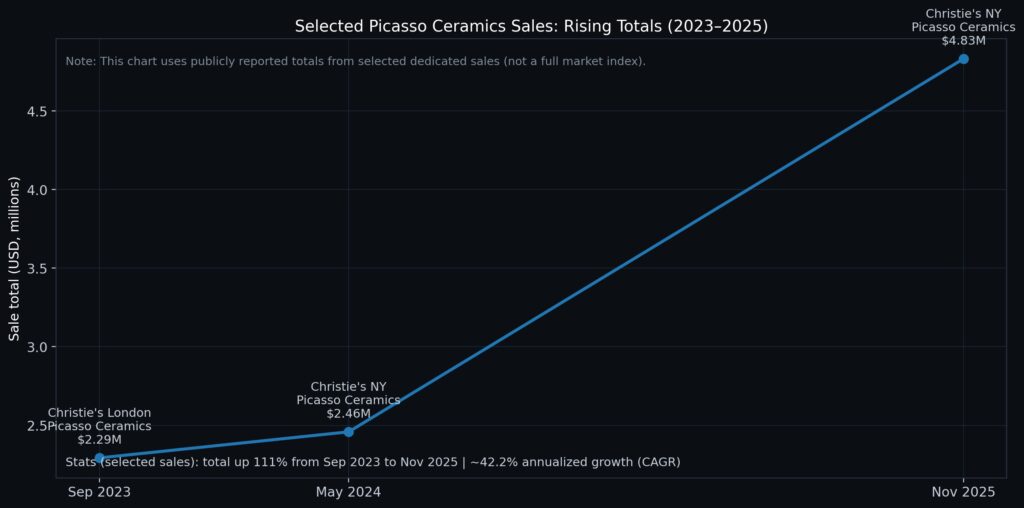
Dedicated auctions remain active: Christie’s May 2025 London sale of 150 Picasso ceramic lots totaled £2,819,880 including buyer’s premium.
The market spans multiple price levels: recent results range from several thousand pounds for editioned plates and plaques to more than $50,000 for substantial pitchers and especially desirable models.
Edition size is not the only driver: several ceramics from editions of 150, 200 and even 500 significantly exceeded their estimates.
Iconic imagery continues to attract bidding: works featuring faces, owls, bulls and other recognizable Picasso motifs achieved notable results during 2025.
Condition matters: auction listings frequently emphasize the absence of chips, cracks and restoration, reinforcing the importance of well-preserved examples.

Picasso Ceramic Auction Results: 2025–2026
Recent sales provide a clearer picture of what collectors are paying for Picasso ceramics and which characteristics can lead to competitive bidding. The following results illustrate the range of the market rather than establishing fixed values; condition, provenance, edition, subject matter and individual quality can all affect the price of a particular example.
Pablo Picasso, Visage, A.R. 288
Christie’s New York sold Visage (A.R. 288), a white earthenware pitcher conceived in 1955 and produced in an edition of 500, for $57,150 in November 2025 against an estimate of $6,000–$8,000. The result demonstrates that a larger edition can still attract substantial demand when the subject, form and visual presence are particularly compelling.
Pablo Picasso, Visage no. 101, A.R. 475
Visage no. 101 (A.R. 475), a ceramic plate from an edition of 150, realized $38,100 at Christie’s New York in November 2025 against an estimate of $4,000–$6,000. Christie’s reported no chips, cracks or restoration, although minor firing characteristics were present.
Pablo Picasso, Personnages no. 28, A.R. 463
Another ceramic plate, Personnages no. 28 (A.R. 463), also from an edition of 150, realized $33,020 against a $5,000–$7,000 estimate in the same November 2025 Christie’s sale.
Pablo Picasso, Visage au nez noir, A.R. 609
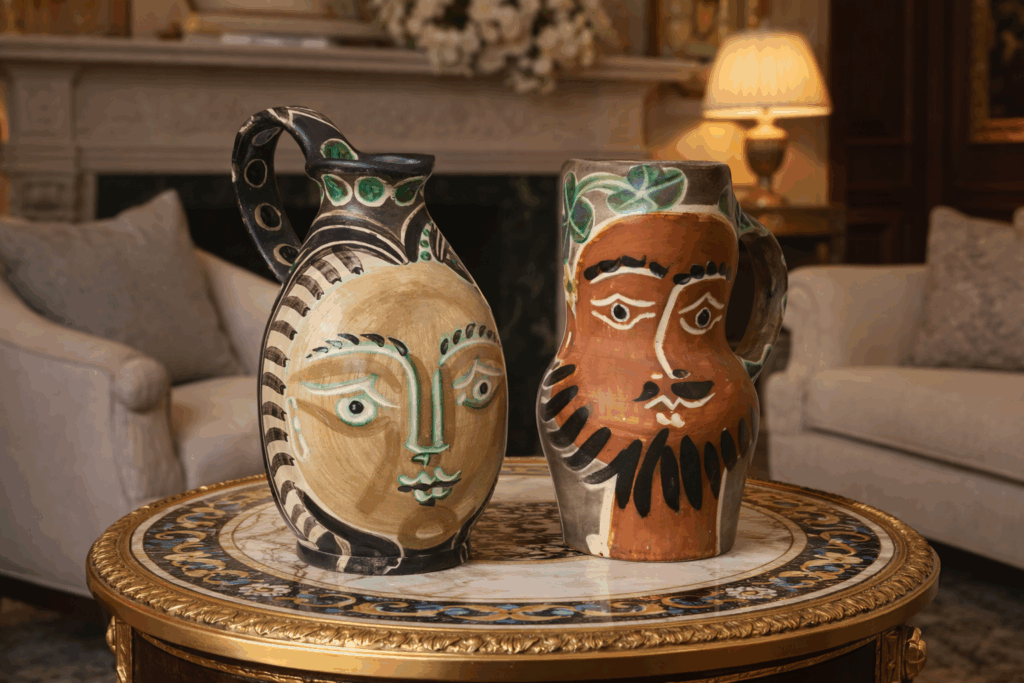
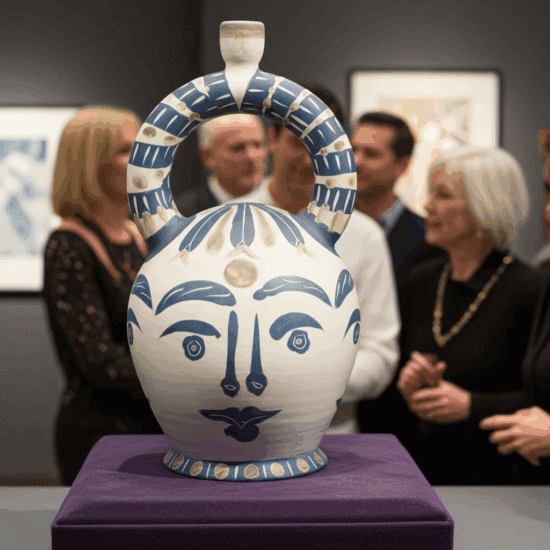
At Christie’s London in May 2025, the substantial pitcher Visage au nez noir (A.R. 609), from an edition of 200, sold for £56,700 against an estimate of £30,000–£50,000. The work was described as generally in very good condition, with no chips, cracks or restoration detected.
Pablo Picasso, Petite chouette, A.R. 83
Smaller works also attracted competitive bidding. Petite chouette (A.R. 83), a small ceramic jug from an edition of 200, realized £10,710 in May 2025 against an estimate of £1,500–£2,500.
Pablo Picasso, Chouette visage de femme, A.R. 144
Chouette visage de femme (A.R. 144), a ceramic vase combining two highly recognizable Picasso motifs, sold for £10,080 against a £6,000–£8,000 estimate at Christie’s London in May 2025.
These results show why Picasso ceramic values cannot be reduced to edition size alone. In 2025, strong results appeared across editions ranging from 150 to 500 examples, with iconic imagery, strong forms, condition and visual impact often proving as important as scarcity. Auction estimates should also be viewed as guides rather than fixed valuations; competitive bidding can produce results substantially above estimate for particularly desirable works.
What Is Driving Demand for Picasso Ceramics?
Recognizable Picasso Imagery
Faces, owls, bulls, animals and figural imagery remain immediately identifiable and can attract broader collector interest than less familiar designs.
Sculptural Forms
Pitchers, vases and three-dimensional ceramics can command particular attention because the ceramic form itself becomes part of Picasso’s composition.
Condition
Buyers generally place a premium on examples without significant chips, cracks or restoration, while firing irregularities inherent to production must be distinguished from later damage.
Rarity and Edition
Smaller editions can contribute to scarcity, but recent results demonstrate that edition size alone does not determine demand or value.
Documentation and A.R. References
Clear Alain Ramié catalogue documentation, appropriate Madoura markings and well-documented provenance help buyers evaluate a work with greater confidence.
Picasso Ceramic Marks, Stamps & Signatures →

Which Picasso Ceramics Are Attracting Collector Attention?
Recent auction results suggest that collector demand remains broad, but certain characteristics repeatedly attract attention. Recognizable imagery, strong sculptural forms, good condition and visual impact can all contribute to competitive bidding.
Faces and Portraits
Picasso's faces remain among the most recognizable subjects in his ceramic oeuvre. Recent results for works such as Visage, Visage no. 101 and Visage au nez noir demonstrate continued collector interest across different forms and edition sizes.
Owls and Animals
Owls remain closely associated with Picasso's ceramics, while bulls, fish, goats and other animals also appeal to collectors. The strong 2025 result for Petite chouette illustrates how even a relatively small ceramic can attract competitive bidding when the imagery is particularly desirable.
Pitchers, Vases and Sculptural Forms
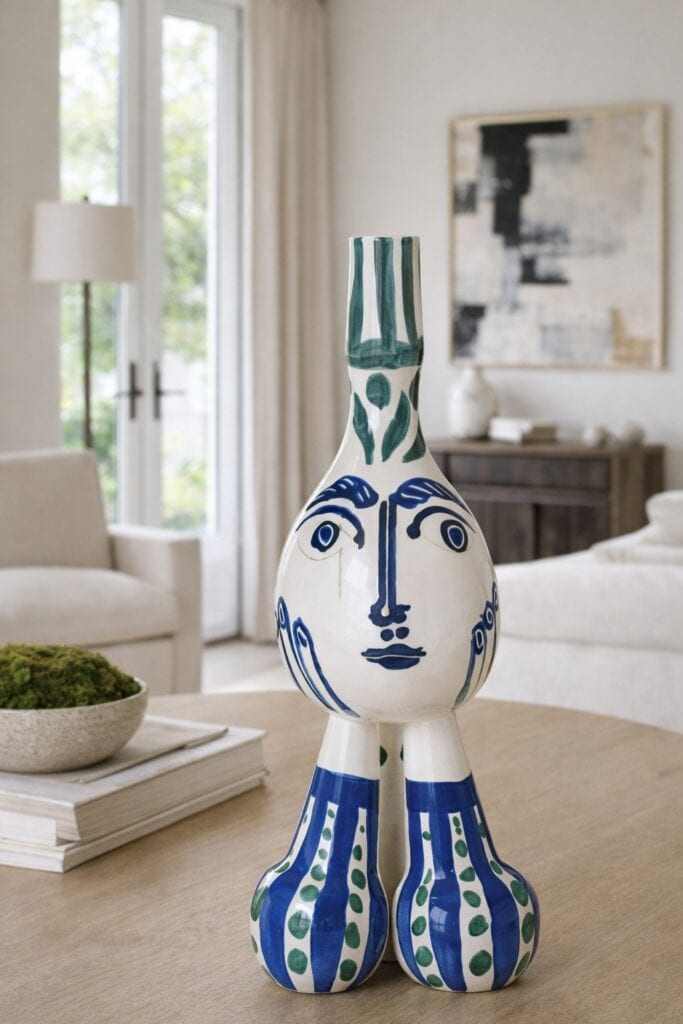
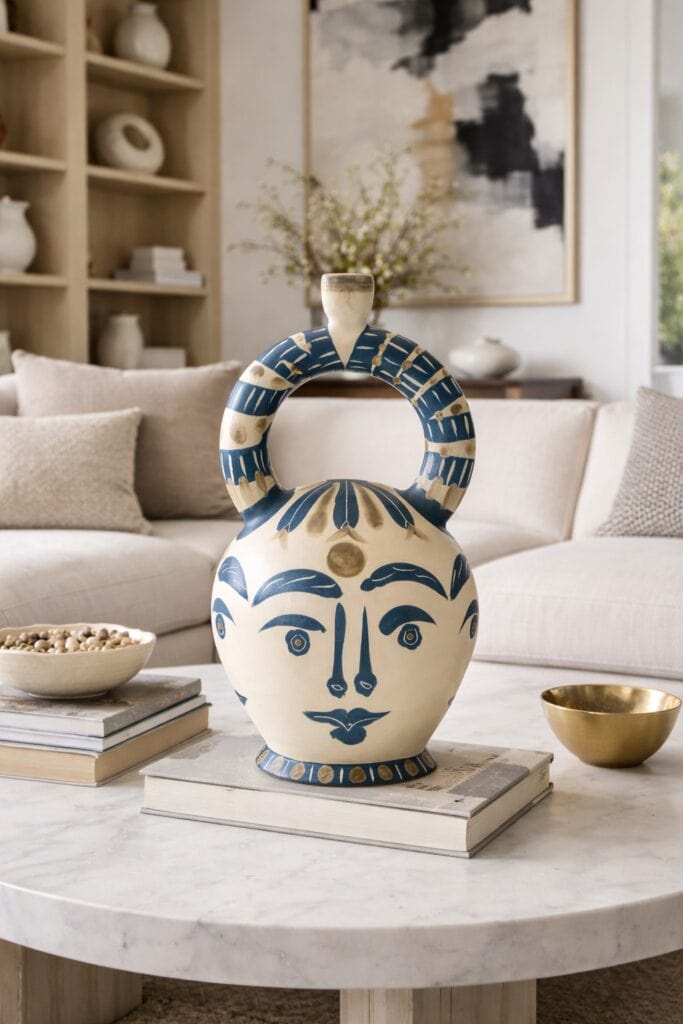
Three-dimensional forms can have particular visual presence because Picasso incorporated the shape of the vessel into the composition. Faces, animals and figures often wrap around or transform the ceramic itself, giving these works a sculptural quality.
Well-Preserved Examples
Condition remains an important differentiator. Examples without significant chips, cracks or restoration may be particularly attractive to collectors, although original firing irregularities and glaze characteristics should not automatically be confused with later damage.
What the Picasso Ceramics Market Means for Buyers
Strong auction results can create urgency, but buyers should avoid purchasing a Picasso ceramic based on recent prices alone. Two examples of the same model or edition can differ in condition, visual quality, provenance and documentation, all of which can affect desirability.
Before purchasing, compare the work with its Alain Ramié (A.R.) catalogue reference, examine its condition and markings, understand the edition, and consider how the asking price compares with relevant recent sales. Most importantly, choose a work you would be pleased to own regardless of short-term market movements.
The Complete Guide to Buying Picasso Ceramics →
What the Picasso Ceramics Market Means for Sellers
Recent auction activity can provide useful benchmarks for owners considering a sale, but an individual ceramic should be evaluated on its own merits. A.R. reference, edition, subject, form, condition, provenance and current collector demand can all influence its marketability.
Owners should also distinguish between an auction estimate, a hammer price and the final price including buyer's premium when comparing recent results. These figures are not interchangeable and can give very different impressions of value.
Masterworks Fine Art evaluates individual Picasso ceramics and collections for owners considering a sale.
Sell Your Pablo Picasso Ceramic →
Picasso Ceramics Market Outlook for 2026
The Picasso ceramics market enters 2026 with an established international collector base and a wide range of works available at different price levels. Recent auction results demonstrate that demand can be particularly competitive for ceramics combining recognizable imagery, strong forms and good condition.
Rather than assuming that all Picasso ceramics will move together, collectors should watch comparable auction results, sell-through rates, condition, edition scarcity and demand for individual subjects and forms. These indicators provide a more useful picture of the market than headline prices alone.
Buying and Selling Picasso Ceramics with Masterworks Fine Art
Masterworks Fine Art has specialized in works by Pablo Picasso for more than 30 years. Our Picasso ceramics are researched with reference to the appropriate catalogue raisonné and are accompanied by documentation supporting authenticity, condition and provenance.
Whether you are looking to acquire a Picasso ceramic or considering selling an individual work or collection, our gallery can provide specialist guidance based on the specific ceramic and current market.
Explore Picasso Ceramics Available for Sale →
Sell Your Pablo Picasso Ceramic →

Picasso Ceramics Market FAQ
Are Picasso ceramics increasing in value?
Some Picasso ceramics have achieved strong recent auction results, but performance varies significantly by work. Subject matter, form, rarity, condition, provenance and collector demand can all influence value, and past auction results do not guarantee future appreciation.
Which Picasso ceramics are most valuable?
Rare unique works and particularly desirable editioned ceramics can command substantial prices, but there is no single category that is always most valuable. Sculptural forms, recognizable imagery, rarity, condition and provenance can all contribute to stronger market demand.
Does a smaller Picasso ceramic edition mean a higher value?
Not necessarily. A smaller edition may increase scarcity, but recent auction results show that ceramics from larger editions can achieve higher prices than smaller editions when the subject, form, condition and visual quality are particularly desirable.
Where can I find recent Picasso ceramic auction results?
Major auction houses publish results from Picasso ceramic sales, while specialist dealers and market guides can help place individual results in context. When comparing prices, confirm whether the figure represents the hammer price or includes buyer's premium.

Continue Exploring Picasso Ceramics
The Complete Guide to Buying Picasso Ceramics
Learn what to look for when buying an original Picasso ceramic, including authenticity, A.R. catalogue references, Madoura markings, editions, condition, provenance and value.
Explore the Picasso Ceramics Buying Guide →
Picasso Ceramics: Unique Works vs. Editions
Understand the differences between Picasso’s one-of-a-kind ceramics and authorized Madoura editions, including how rarity, edition size and production method can influence collectibility and value..
Explore Unique Works vs. Editions →
Picasso Ceramic Marks, Stamps & Signatures
Learn how to identify Picasso ceramic marks, Madoura stamps, signatures and edition notations used to help authenticate and document original Picasso ceramics.
Explore Picasso Ceramic Marks & Stamps →
Value of Picasso Ceramics
Discover the key factors that influence Picasso ceramic values, including rarity, subject, form, condition, edition size and collector demand.
Explore the Picasso Ceramics Value Guide →
How Picasso Made His Ceramics
Discover the techniques Picasso used at the Madoura Pottery, from painted and glazed ceramics to engraved, modeled and editioned works.
Explore Picasso’s Ceramic Techniques →
Picasso in Vallauris
Learn how Picasso’s years in Vallauris transformed his approach to ceramics and led to one of the most important periods of ceramic production in modern art.
Explore Picasso in Vallauris →
Picasso and the Madoura Pottery: Ceramics, History and Editions
Discover Picasso’s collaboration with Suzanne and Georges Ramié at the Madoura Pottery and how the workshop helped produce his celebrated ceramic works and editions.
Explore Picasso and the Madoura Pottery →
This article was updated on 20 August 2026.